Blue Jay Gold Intersects 14.0 m of 6.15 g/t Gold and 124 g/t Silver at Skukum Creek, Including 10.5 m of 7.84 g/t Gold and 154 g/t Silver
10.19 g/t AuEq over 10.50 m marks the highest-grade intercept of down-plunge extension
VANCOUVER, British Columbia, Sept. 14, 2026 (GLOBE NEWSWIRE) — Blue Jay Gold Corp. (TSXV: JAY) (OTCQB: JAYGF) (FSE: JAY) (“Blue Jay” or the “Company”), is pleased to announce the first assay results from its maiden 2026 diamond drill program at the Steller Gold Project (“Steller” or the “Project“) in the Yukon Territory. Hole SC26-003 returned 14.00 metres (m) of 6.15 grams per tonne (g/t) gold (Au) and 124 g/t silver (Ag), or 8.04 g/t gold equivalent (AuEq), from 495.00 m, including 10.50 m of 7.84 g/t Au and 154 g/t Ag (10.19 g/t AuEq). The intersection represents an approximate 32 m down-plunge extension of the mineralization intersected in drill hole SC21-027, which returned 14.8 m of 5.79 g/t Au and 100.9 g/t Ag in 20211. The results highlight continuity of the mineralization and its host structure across multiple intercepts, with room for further expansion. The system displays an intermediate sulfidation epithermal style comparable to giant districts such as Fresnillo, Zacatecas and Pachuca in Mexico. Intercepts extending from surface to over 500 m down dip demonstrate the continuity and scale potential of the Skukum Creek system. Initial drilling at Mt. Skukum, the site of historical gold production between 1986 and 1988, returned 0.5 m of 57.4 g/t Au and 44.1 g/t Ag from 160.8 m in hole MS26-001. The historical high-grade production at Mt. Skukum, combined with the presence of multiple undertested vein sets, points to resource growth potential on this target corridor. The Company has identified similar potential for expansion along strike at other target areas across the Project’s 170 km² land package.
“SC26-003 is the kind of result we underwrote when we bought this project,” said Geordie Mark, CEO of Blue Jay Gold. “It confirmed mineralization more than 30 metres down-plunge of SC21-027, drilled in 2021, with effectively the same width, grade and grade distribution. That is what continuity looks like: not just a string of separate hits, but a zone you can follow. We identified this area as being completely open to depth and down-plunge. That was the call, and we have delivered results that exemplify our thesis.”
Most exploration programs start with a blank map. Steller handed us one already partly drawn, aided by historical drilling, 7.5 kilometres of underground development, and a high-grade resource in the ground. What has never existed is a structural framework that explains where the grade goes, and a hydrothermal model that predicts where other mineralized systems could be.”
“Hyperspectral core logging is central to how we are building it,” added Mark. “We have now put roughly 18,000 metres of historical core through the scanner system, reading alteration mineral distribution and chemistry directly from the core ahead of assay results from the lab. It shows a consistent, zoned alteration envelope around the mineralized structures that points toward mineralization. Every metre we scan turns rock we already own into data we can use to refine targets.
At Mt. Skukum, our first hole returned a high-grade intercept at the site of the former Mt. Skukum mine, which produced gold between 1986 and 1988. Seeing grades of that order in our own first holes tells us the system at Steller is not confined to a single deposit.
We are only about 3 months after listing, and the picture we formed in due diligence of Steller is holding. Rigs are turning and assays are pending on further holes. Today’s results are the first assay confirmation that the framework we are building points the right way.”
Highlights
- High-grade down-plunge extension at Rainbow Zone at Skukum Creek: 14.0 m of 6.15 g/t Au and 124.1 g/t Ag (8.04 g/t AuEq) from 495.0 m in SC26-003, including 10.50 m of 7.84 g/t Au and 154.0 g/t Ag (10.19 g/t AuEq), approximately 32 m below SC21-027 (14.8 m of 5.79 g/t Au, 100.9 g/t Ag) (Figure 1).
- Mineralization is continuous within the structure between drill holes: SC26-003 returned essentially the same width and grade as SC21-027, which is >30 m up-plunge. The structure carries consistent gold and silver tenor between the two holes rather than occurring as isolated lenses.
- Our interpretation, now drill-tested: we projected that this zone was open. SC26-003 is the first drilling phase to test it and has unearthed that reality.
- Hyperspectral logging of 18,000 m of core has produced a vectoring tool: a consistent, zoned alteration envelope wrapped around the mineralized structures, measurable directly in core and applicable to material already in the core yard. It has generated new targets along the Skukum Creek Structural Corridor.
- First drilling at Mt. Skukum returns high-grade gold: MS26-001 returned 0.5 m of 57.4 g/t Au from 160.8 m, on the site of the former Mt. Skukum gold mine, which recovered 77,790 ounces of gold between 1986 and 1988.
- Initial batch of many: 5 holes are reported today, with assays pending for further holes that have been completed. Mineralization at Skukum Creek remains open down-plunge and along strike, and rigs are turning.
- 2026 Technical Report. TECHNICAL REPORT AND UPDATED MINERAL RESOURCE ESTIMATE OF THE STELLER GOLD PROJECT, WHITEHORSE MINING DISTRICT, YUKON TERRITORY, CANADA. P&E Mining Consultants Inc. Effective Date: Oct. 31, 2025. Cut-off: 3.0 g/t AuEq. Au: US$2,850/oz. Ag: US$34.20/oz. AuEq ratio = Au:Ag 85.6:1
Figure 1: Cross-section through the Rainbow zone that highlights the continuity of the Au-Ag mineralization, and the >30 metre down dip extension of SC-26-003 compared with the most proximal intersection (SC-21-027). Holes being surveyed during drilling.
Table 1: Assay Results
| Location | From (m) | To (m) | Au (g/t) | Ag (g/t) | AuEq (g/t)1 | Interval (m) |
| Skukum Creek | ||||||
| SC-26-003 | 495.00 | 509.00 | 6.15 | 124.0 | 8.04 | 14.00 |
| including | 498.50 | 509.00 | 7.84 | 154.0 | 10.19 | 10.50 |
| And including | 499.60 | 504.00 | 12.00 | 258.0 | 15.94 | 4.40 |
| SC-26-001 | 444.63 | 448.96 | 4.63 | 74.0 | 5.76 | 4.33 |
| SC-26-004* | 377.00 | 378.00 | 1.15 | 0.2 | 1.15 | 1.00 |
| Mt. Skukum | ||||||
| MS (26-01) | 160.80 | 161.30 | 57.40 | 44.1 | 58.07 | 0.50 |
This press release is reporting on the first three holes at Skukum Creek hole 1, 3 and 4 and holes 1 and 4a at Mt. Skukum which is 200 samples in total. True widths are estimated at approximately 60-80 % of the down-hole interval based on currently available results and observations. Interval average grades are calculated using un-capped assays. Composites are calculated using a 1.0 g/t AuEq cut-off grade with a maximum of 2.0 m of internal dilution of below-cut-off material and a minimum composite length of 1.0 m.
- Gold equivalent (AuEq) is calculated as AuEq (g/t) = Au (g/t) + [Ag (g/t)]*($67*0.93/$4300*0.95)], using US$4,300/oz gold and US$67.00/oz silver. Project recoveries of 95% for gold and 93% for silver and are consistent with the assumptions used in the Mineral Resource Estimate with an effective date of October 31, 2025. AuEq values are provided for comparison only and do not reflect payable metal.
Hole SC26-001 returned 4.33 m of 4.63 g/t Au and 74.0 g/t Ag (5.76 g/t AuEq) from 444.63 m to 448.96 m, lending further support to the continuity of mineralization at Skukum Creek. Hole SC26-004 deviated from its planned trajectory and did not reach its intended target, returning 1.00 m of 1.15 g/t Au and 0.2 g/t Ag (1.15 g/t AuEq) from 377.00 m to 378.00 m in a separate zone for subvertical Au-Ag mineralization. The Company plans to re-drill this target in a future phase of the program.
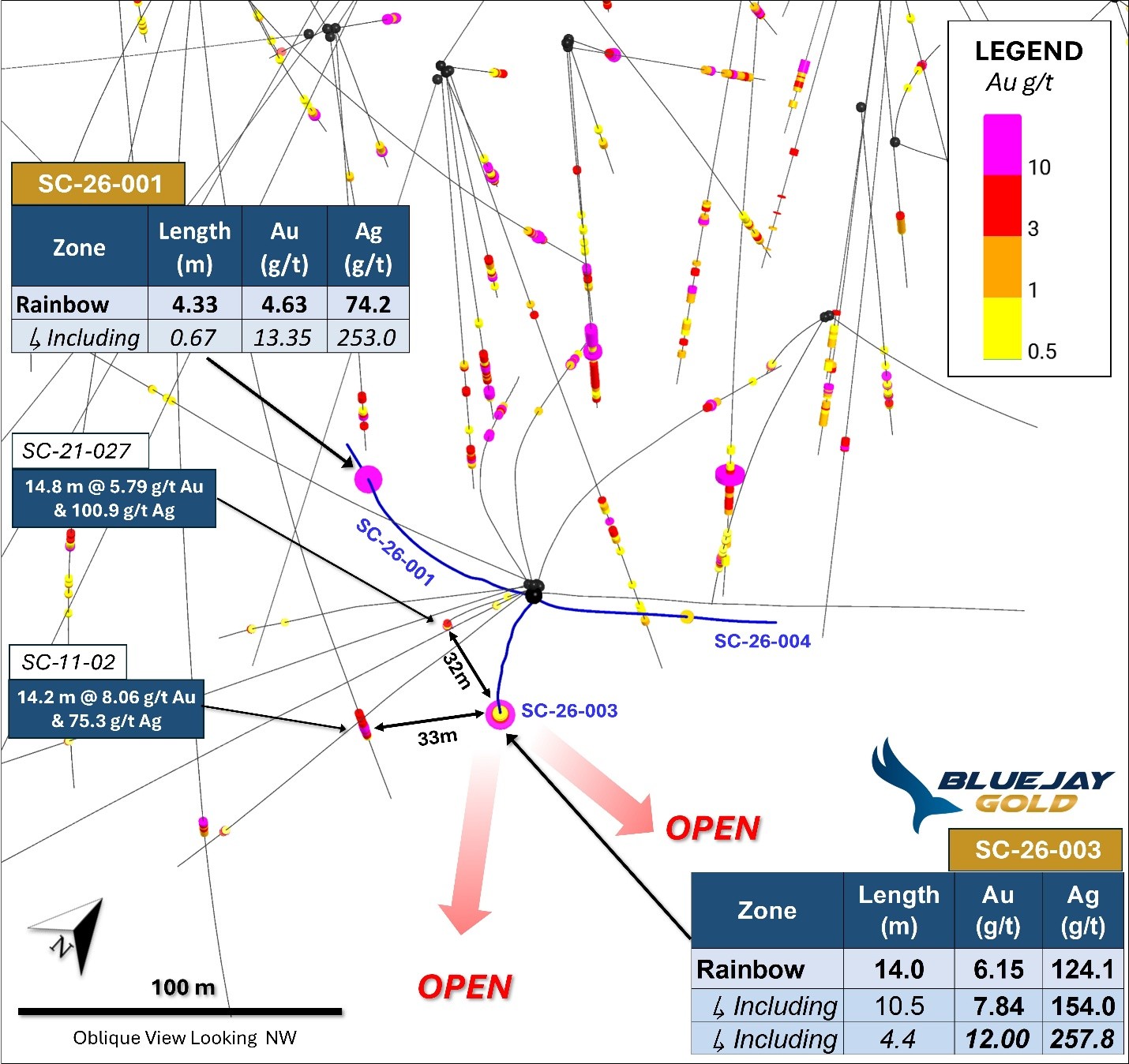
Figure 2: Skukum Creek Plan Section showing drill traces for initial holes from 2026, compared with historical holes on the Northeast portion of the deposit area. Note that SC-26-004 drill hole deviated off target and out of structural plane.
Table 2: Drill Hole Collar Locations
| Hole ID | East | North | Elevation | Depth | Dip | Azimuth |
| SC-26-001 | 478102 | 6671141 | 1386 | 529 | -52 | 300 |
| SC-26-003 | 478102 | 6671141 | 1386 | 542 | -56 | 307.5 |
| SC-26-004 | 478102 | 6671141 | 1386 | 537 | -56 | 314.5 |
| MS-26-001 | 473531 | 6674889 | 1913 | 222 | -66.5 | 065 |
| MS-26-004A | 473455 | 6674883 | 1916 | 213 | -54 | 112 |
Next Steps
Drilling is ongoing. Follow-up holes are being planned to test further down-plunge and along strike continuity of mineralization on the Rainbow zone. Drill results are expected to be delivered from Skukum Creek and other target areas on Steller during and post the completion of the exploration program.
Drilling and Geology Discussion
Structural Setting and Controls on Mineralization
The 2026 Skukum Creek drill program is testing structural extensions to Au-Ag mineralization hosted within composite breccia-shear zones. These zones acted as fluid conduits and record multiple pulses of overprinting hydrothermal alteration, Au-(Ag) mineralization and coeval felsic to intermediate dyking, all formed during the Eocene. This system is comparable to major epithermal districts including Guanajuato, Pachuca-Real del Monte, Fresnillo and Tayoltita in Mexico, and the Comstock district in Nevada and Creede in Colorado in the United States. These districts share a similar Eocene-Oligocene age and formed within calderas and large volcanic complexes, comparable to the geological systems preserved across the Stellar project.
Rainbow Zone Down-Plunge Extension
The holes reported today are the first tranche of results from the 2026 program and test the down-plunge extension of the Rainbow Zone.
SC26-003 extends high-grade Au-Ag mineralization >30 m down-plunge of SC-21-027, drilled in 2021. The intersection grades 8.04 g/t AuEq. over 14 m and preserves the across-structure grade distribution seen up-plunge. Equally important, the holes confirm that the bounding structures are continuous and that they remained active as conduits through repeated pulses of hydrothermal alteration, mineralization and Eocene dyking. This dyking is comparable to that found in the Mexican examples of major intermediate sulfidation systems, which can extend more than 1 km vertically and 8 km along strike, forming multi-million AuEq systems that enjoyed protracted mining histories. Our framework exploration represents the first systematic integration of Steller’s historical data within the geological context of these major epithermal systems and the application of next generation geological tools (e.g., LithologIQ) to unravel Stellar’s potential.
Not to be overlooked, SC26-001 returned 4.33 metres grading 5.70 g/t AuEq. on the Rainbow Zone and importantly shows continuity of the structure that hosts mineralization. The Au-Ag mineralization is hosted within composition vein-breccia that is spatially associated with the same alteration patterns witnessed in SC26-003, as such we are developing an improved confidence in the hydrothermal evolution of this system.
Hyperspectral Core Logging and Alteration Zoning
Blue Jay has completed hyperspectral logging of approximately 18,000 m of archived drill core. The results show a consistent, zoned alteration envelope along and up-dip of the mineralized structures. Measured as down-hole lengths outward from the mineralized zone, the envelope grades from an outer white-mica-rich halo of more than 100 m, through an inner halo of up to 90 m in which chlorite becomes progressively more Fe-rich, to a proximal zone of tens of metres in which hydrothermal carbonate is Mg-rich.
The practical value is vectoring. The zoning is measurable in core, it repeats across holes, and it can be applied to material already in the core yard. It has generated new targets within the strike length of the mineralized corridor. This begins to define the scale potential for multiple target areas that warrant broad step out drilling.
The Skukum Creek Structural Corridor
Skukum Creek mineralization is currently defined over a strike length of more than 1 km. It sits within the Skukum Creek Structural Corridor, which extends for more than 15 km as defined by regional magnetic data and comprises a zone of multiple sub-parallel and curvilinear structures: the continuity and distribution of these structures were unmapped before magnetics could be interrogated.
These structures are interpreted as second order features relative to a longer-wavelength, north-south trending, deeper penetrative structure that shows spatial association with Eocene dyke swarms. Both the corridor length and the structural hierarchy are interpretations drawn from airborne magnetics, that was reprocessed and reinterpreted in 2026.
District-Scale Associations
The same spatial and temporal associations between alteration, mineralization, dyking and dilation are seen at Raca, at Goddell Gully, and more broadly across the Tellurium-rich, low sulphidation epithermal vein field at Mt. Skukum. North-south and east-west trending composite dyke swarms are documented across that field and around Skukum Creek, Raca, Chieftain and Goddell. Comparable associations are mapped historically along east-west trending composite dyke sets of rhyolitic, andesitic and quartz-feldspar porphyry composition east of Skukum Creek, where copper- and molybdenum-bearing mineralization is also present.
At depth in the altered footwall of the Rainbow Zone, a sub-population of quartz-pyrite-molybdenite veins has been documented. These form part of a hydrothermal evolution progressing from early potassic alteration, through localized magnetite alteration and sericite-quartz-chlorite alteration, to Au-Ag mineralization with Mg-rich carbonate, and finally to late low-temperature epithermal quartz veining. This progressive hydrothermal, magmatic and chemical evolution bears similarities to the geological systems documented in Guanajuato and Creede Colorado.
That progression, together with the copper-molybdenum mineralization east of Skukum Creek and the quartz-feldspar porphyry dykes, is interpreted as consistent with hydrothermal centres being driven by magmatic intrusions at depth. No drilling has ever tested that integrated interpretation, and no such target construction has been defined before.
Oriented Core
Oriented core is being collected at Steller and will be used for the first time in the property’s history. It is one of the defining elements of this framework year of exploration and gives Blue Jay the capacity to target future drilling across a project that shows district-scale mineralization with broad commonalities within a major regional architecture.
Market Making Engagement
The Company announces that it has engaged the services of ICP Securities Inc. (“ICP”) to provide automated market making services, including use of its proprietary algorithm, ICP Premium® in compliance with the policies and guidelines of the TSX Venture Exchange (the “Exchange”) and other applicable legislation. ICP will be paid a monthly fee of C$7,500, plus applicable taxes. The agreement between the Company and ICP was signed with a start date of September 10th, 2026, and is for four (4) months (the “Initial Term”) and shall be automatically renewed for subsequent one (1) month terms (each month called an “Additional Term”) unless either party provides at least thirty (30) days written notice prior to the end of the Initial Term or an Additional Term, as applicable. There are no performance factors contained in the agreement and no stock options or other compensation in connection with the engagement. ICP and its clients may acquire an interest in the securities of the Company in the future. The Company’s engagement of ICP remains subject to the approval of the Exchange.
ICP is an arm’s length party to the Company. ICP’s market making activity will be primarily to correct temporary imbalances in the supply and demand of the Company’s shares. ICP will be responsible for the costs it incurs in buying and selling the Company’s shares, and no third party will be providing funds or securities for the market making activities.
Quality Assurance and Quality Control
Drill core was transported from the drill platform to the logging facility where it was logged, photographed, and samples split by diamond saw. Samples were then bagged, and a blank, duplicate or certified reference material inserted into the sample stream every 10 samples. Samples were submitted by hole, and placed in large sacks, sealed with numbered tags in order to maintain a chain-of-custody, and transported to ALS Laboratories in Whitehorse, Yukon where they were shipped by ALS to the prep and analytical lab in North Vancouver, British Columbia.
Individual samples were crushed to 2mm (10 mesh) and a 250g split was ground until at least 85% of the material passes through a 75-micron (75 µm / <200 mesh) screen. Samples were prepared for analysis according to ALS method ME-MS61 where multi-element (48) geochemical analysis was performed by four-acid digest of a 0.25g split followed by a combination of ICP-AES and ICP-MS finishes. Over-limits for gold and silver samples were re-analyzed using ALS method ME-GRA21 where a 30g split is analyzed with fire assay and gravimetric finish.
All results passed the QA/QC screening at the lab, all company inserted standards and blanks returned results that were within acceptable limit.
Qualified Person
The scientific and technical content of this news release has been reviewed and approved by Freeman Smith, P.Geo., VP Exploration of Blue Jay Gold Corp., who is a Qualified Person as defined by National Instrument 43-101 – Standards of Disclosure for Mineral Projects.
About ICP Securities Inc.
ICP Securities Inc. is a Toronto based CIRO dealer-member that specializes in automated market making and liquidity provision, as well as having a proprietary market making algorithm, ICP Premium®, that enhances liquidity and quote health. Established in 2023, with a focus on market structure, execution, and trading, ICP has leveraged its own proprietary technology to deliver high quality liquidity provision and execution services to a broad array of public issuers and institutional investors.
About Blue Jay Gold Corp.
Blue Jay Gold Corp. is a Canadian gold exploration company focused on growing and discovering resources within established gold producing regions in Canada. The Company’s flagship asset is the 100%-owned Steller Gold Project in southern Yukon, an infrastructure-supported, past-producing mine with significant exploration upside and clear near-term catalysts. Blue Jay has also built a portfolio of projects in Ontario. With strategically located assets and a leadership team experienced in geology and capital markets, Blue Jay will advance disciplined, modern exploration programs focused on target definition, resource growth, and new discoveries in known gold-mineralized regions. For more information, please visit: www.bluejaygoldcorp.com.
ON BEHALF OF BLUE JAY GOLD CORP.
signed “Geordie Mark”
Geordie Mark, CEO
For additional information contact:
BLUE JAY GOLD CORP.
| Geordie Mark CEO Blue Jay Gold Corp. info@bluejaygoldcorp.com Phone: (604) 235-4059 | Eric Negraeff Investor Relations Blue Jay Gold Corp. eric@bluejaygoldcorp.com Phone: (604) 235-4059 |
Cautionary Note Regarding Forward-Looking Statements
Certain statements in this press release contain forward-looking information. Forward-looking information involves risks, uncertainties and other factors that could cause actual results to differ materially from those expressed or implied by such forward-looking information. In addition, the forward-looking statements require management to make assumptions and are subject to inherent risks and uncertainties. There is significant risk that the forward-looking statements will not prove to be accurate, that the management’s assumptions may not be correct and that actual results may differ materially from such forward-looking statements.
These statements can be identified by the use of forward-looking terminology (e.g., “expect”,” estimates”, “intends”, “anticipates”, “believes”, “plans”). Forward-looking statements contained in this press release may include, but are not limited to, the results of the Skukum Creek drill program (including drilling of the Rainbow Zone and other areas of Steller), the timing and scope of the rest of the Company’s exploration program, and future business plans of the Company. Such information involves known and unknown risks, including the receipt of regulatory approval, the results of future financing and exploration activities, the interpretation of exploration results and other geological data, or unanticipated costs and expenses and other risks identified by Blue Jay in its public securities filings that may cause actual events to differ materially from current expectations. Readers are cautioned not to place undue reliance on these forward-looking statements, which speak only as of the date of this press release. Except as required by applicable securities laws and regulation, Blue Jay disclaims any intention or obligation to update or revise any forward-looking statement, whether as a result of new information, future events or otherwise.
Photos accompanying this announcement are available at:
https://www.globenewswire.com/NewsRoom/AttachmentNg/13c6cc00-5441-40b1-bc19-27c5c6a877c2
https://www.globenewswire.com/NewsRoom/AttachmentNg/161f3677-c0b5-4fad-980a-214d386c90ba