Cogent Biosciences Announces Detailed Clinical Data from PEAK Phase 3 Trial with Bezuclastinib in Combination with Sunitinib in Gastrointestinal Stromal Tumors (GIST) at 2026 American Society of Clinical Oncology (ASCO) Annual Meeting
Bezuclastinib combination is first treatment ever to demonstrate statistically significant advantage against active comparator in GIST patients; median PFS of 16.5 months versus 9.2 months (HR=0.50, CI: 0.39-0.65, p<0.0001) for bezuclastinib combination compared to sunitinib alone
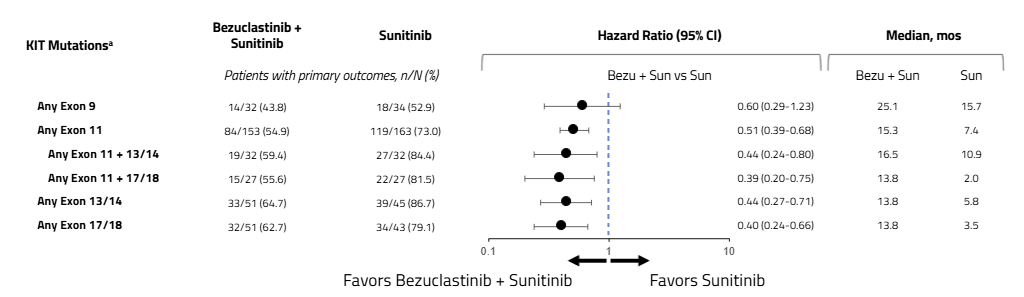
Bezuclastinib combination provides clear PFS benefit regardless of primary or secondary KIT mutations
Mean duration of treatment estimated at 21.4 months for patients receiving bezuclastinib combination
Bezuclastinib combination well tolerated with no unique risks observed with the combination when compared to the known safety profile of sunitinib
Priority Review granted following FDA acceptance of NDA for bezuclastinib combination in GIST patients who previously received imatinib; PDUFA date scheduled for November 30, 2026
Cogent announces initiation of new clinical trial of bezuclastinib combination in 1L GIST patients
WALTHAM, Mass. and BOULDER, Colo., May 30, 2026 (GLOBE NEWSWIRE) — Cogent Biosciences, Inc. (Nasdaq: COGT), a biotechnology company focused on developing precision therapies for genetically defined diseases, today announced detailed clinical data from the primary analysis of the PEAK Phase 3 trial of bezuclastinib in combination with sunitinib in patients with Gastrointestinal Stromal Tumors (GIST) who have received prior treatment with imatinib.
The presentation titled Primary Results of the Phase 3 Peak Study of Bezuclastinib + Sunitinib vs Sunitinib Monotherapy in Advanced Gastrointestinal Stromal Tumors (GIST) will be presented by Andrew Wagner, M.D., Ph.D., Senior Physician, Center for Sarcoma and Bone Oncology, Dana-Farber Cancer Institute, and Associate Professor of Medicine, Harvard Medical School at the American Society of Clinical Oncology (ASCO) annual meeting and will be available on the Cogent website at https://www.cogentbio.com/pipeline-publications/#posters-publications.
“We are thrilled with the results from the PEAK Phase 3 trial demonstrating a statistically significant and clinically meaningful improvement in progression-free survival and objective response rate with bezuclastinib in combination with sunitinib compared to sunitinib alone,” said Andrew Robbins, President and Chief Executive Officer of Cogent Biosciences. “Importantly, there was a clear benefit across all mutational patient subgroups, coupled with a safety profile generally consistent with the known profile of single agent sunitinib. Building on our announcement that the bezuclastinib combination was granted FDA Priority Review earlier this week, we plan to launch bezuclastinib later this year and are well prepared to ensure bezuclastinib combination access for GIST patients in need.”
“The results presented today clearly demonstrate that the combination of bezuclastinib and sunitinib provides impressive clinical activity for patients with KIT-driven gastrointestinal stromal tumors,” said Andrew Wagner, M.D., Ph.D., Senior Physician, Center for Sarcoma and Bone Oncology, Dana-Farber Cancer Institute, and Associate Professor of Medicine, Harvard Medical School. “I am very excited about the potential for this combination and expect it will be rapidly adopted as the new standard of care for patients with second-line GIST.”
PEAK Phase 3 Trial Results
As reported in November 2025, PEAK is a global, randomized Phase 3 clinical trial evaluating bezuclastinib in combination with sunitinib vs. sunitinib monotherapy in patients with imatinib-resistant or intolerant GIST. As of the cutoff date, September 30, 2025, the bezuclastinib combination demonstrated a substantial and highly statistically significant clinical benefit on the primary endpoint of PFS, reducing risk of disease progression or death compared to the current standard of care by 50% (hazard ratio of 0.50, 95% CI: 0.39 – 0.65). mPFS, as assessed by blinded independent central review, was 16.5 months for the bezuclastinib combination vs. 9.2 months for sunitinib monotherapy. Additionally, the bezuclastinib combination demonstrated an unprecedented ORR in imatinib-resistant patients, with 46% of patients treated with the bezuclastinib combination achieving an objective response compared to 26% of patients treated with sunitinib. Data for overall survival remains immature.
Based on the ongoing patients receiving treatment on the bezuclastinib arm as of March 31, 2026, the mean duration of treatment for the bezuclastinib combination is now estimated to be 21.4 months.
Results of Genotype Subgroup Analysis
Using all genotyping information available at baseline, a comparative analysis of PFS was performed across several patient subgroups based on their primary and secondary KIT mutation status. Across all subgroups, the bezuclastinib combination demonstrated a clear advantage over sunitinib monotherapy.
PFS2 Results
Additional data presented today demonstrate impressive benefit for patients receiving the bezuclastinib combination when measuring PFS2, defined as the time from randomization to progression on the next line of therapy or death. Median PFS2 was not reached versus 21 months (HR=0.57, 95% CI: 0.41-0.78) for patients initially treated with the bezuclastinib combination compared with sunitinib monotherapy. This finding reinforces the durability of clinical benefit for patients receiving the bezuclastinib combination.
Safety Data
As of the data cutoff, the bezuclastinib combination was generally well tolerated, and no unique risks were observed with the novel combination when compared to the known safety profile of sunitinib. The most commonly reported Grade 3+ treatment emergent adverse events in either arm (bezuclastinib combination vs. sunitinib) included: Hypertension (29.4% vs. 27.4%), Neutropenia (15.2% vs. 15.4%), ALT/AST increased (10.8% vs. 1.4%), Anemia (9.3% vs. 4.8%) and Diarrhea (7.8% vs. 7.2%). 7.4% of patients on the bezuclastinib combination and 3.8% of patients on sunitinib monotherapy discontinued study treatment(s) due to treatment related adverse events. Hepatic adverse events were predominantly transient and manageable lab abnormalities; the majority of which were asymptomatic, low grade, non-serious and reversible. In the combination arm, ALT/AST elevations led to bezuclastinib dose reductions in 12.7% of patients with only 3 subjects (1.5%) discontinuing bezuclastinib for ALT/AST elevations. All Grade 3 ALT/AST elevations resolved, and no Grade 4 elevations were reported.
Bezuclastinib Combination in Exon 9 First Line GIST Patients
Cogent also announced today the initiation of a single-arm, 40 patient extension cohort of the PEAK trial investigating the safety and efficacy of the bezuclastinib combination in first-line GIST patients with KIT exon 9 primary mutations who have received limited or no imatinib treatment. This cohort is designed to prospectively measure ORR and PFS in this patient population, building upon the 25.1 mPFS reported in a subgroup of 32 patients with detectable exon 9 mutations treated with the bezuclastinib combination in the Phase 3 PEAK trial.
Bezuclastinib – Expanded Access Program
Working with the FDA, Cogent has established active Expanded Access Programs (EAPs) for U.S. patients with GIST or SM who meet disease-specific criteria and could benefit from treatment with bezuclastinib or the combination of bezuclastinib and sunitinib. For more information please visit: https://www.cogentbio.com/bezuclastinib-program-development/#our-expanded-access-policy
About Cogent Biosciences, Inc.
Cogent Biosciences is a biotechnology company focused on developing precision therapies for genetically defined diseases. The most advanced clinical program, bezuclastinib, is a selective tyrosine kinase inhibitor that is designed to potently inhibit the KIT D816V mutation as well as other mutations in KIT exon 17. KIT D816V is responsible for driving systemic mastocytosis, a serious disease caused by unchecked proliferation of mast cells. Exon 17 mutations are also found in patients with advanced gastrointestinal stromal tumors (GIST), a type of cancer with strong dependence on oncogenic KIT signaling. In addition, the Cogent Research Team is developing a portfolio of novel targeted therapies to help patients fighting serious, genetically driven diseases targeting mutations in ErbB2, PI3Kα, KRAS and JAK2. Cogent Biosciences is based in Waltham, MA and Boulder, CO. Visit our website for more information at www.cogentbio.com. Follow Cogent Biosciences on social media: X and LinkedIn. Information that may be important to investors will be routinely posted on our website and X.
Forward Looking Statements
This press release contains forward-looking statements within the meaning of the Private Securities Litigation Reform Act of 1995, including, but not limited to, statements regarding: the estimated mean duration of treatment for PEAK patients receiving the bezuclastinib combination; plans to launch bezuclastinib later this year and to provide access for GIST patients in need; the commercial potential of the bezuclastinib combination and the expectation that it will be rapidly adopted as the new standard of care for patients with second-line GIST. The use of words such as, but not limited to, “anticipate,” “believe,” “continue,” “could,” “estimate,” “expect,” “intend,” “may,” “might,” “plan,” “potential,” “predict,” “project,” “should,” “target,” “will,” or “would” and similar words expressions are intended to identify forward-looking statements. Forward-looking statements are neither historical facts nor assurances of future performance. Instead, they are based on our current beliefs, expectations and assumptions regarding the future of our business, future plans and strategies, our clinical results, the rate of enrollment in our clinical trials and other future conditions. New risks and uncertainties may emerge from time to time, and it is not possible to predict all risks and uncertainties. No representations or warranties (expressed or implied) are made about the accuracy of any such forward-looking statements. We may not actually achieve the forecasts or milestones disclosed in our forward-looking statements, and you should not place undue reliance on our forward-looking statements. Such forward-looking statements are subject to a number of material risks and uncertainties including but not limited to those set forth under the caption “Risk Factors” in Cogent’s most recent Annual Report on Form 10-K, as supplemented by Quarterly Reports on Form 10-Q and other filings Cogent makes with the SEC from time to time . Any forward-looking statement speaks only as of the date on which it was made. Neither we, nor our affiliates, advisors or representatives, undertake any obligation to publicly update or revise any forward-looking statement, whether as a result of new information, future events or otherwise, except as required by law. These forward-looking statements should not be relied upon as representing our views as of any date subsequent to the date hereof.
Contact:
Christi Waarich
Senior Director, Investor Relations
christi.waarich@cogentbio.com
617-830-1653
A photo accompanying this announcement is available at https://www.globenewswire.com/NewsRoom/AttachmentNg/0bd526c3-2e64-4b0d-8de9-f7c2d662cb4c